
🌡️ Live Local Barometer
Click below to get your hyper-local barometric pressure and headache risk.
Look, I get it. You’re not here for a meteorology lecture. You’re here because your head is pounding, you’re wondering if a storm is rolling in, or you’re trying to figure out if today’s a good day to hit the lake. And honestly? Same.
The thing about barometric pressure is that it’s everywhere—literally, the weight of the entire atmosphere sitting on top of you right now—yet most weather apps treat it like an afterthought. They’ll give you temperature, humidity, wind speed… but the pressure? Buried somewhere in a tiny font, like it’s optional information.
It’s not. It’s the hidden engine driving your weather and your body. So let’s cut the fluff and get straight to what you actually need to know.
What Is the Barometric Pressure Today Near Me? (The Short Answer)
Here’s the quick version: standard sea-level pressure is 29.92 inHg (or 1013.25 mb). Anything near that? You’re in the “normal” zone—think calm skies, stable weather, and minimal pressure-related headaches.
But here’s the catch: “normal” depends on where you are. If you live in Denver, your baseline is lower because you’re a mile above sea level. If you’re tracking the barometric pressure near California or monitoring shifting systems near Texas, your numbers will look different. The key isn’t the number itself—it’s the trend.
Is it rising? Falling? Holding steady? That’s what actually matters.
How to Track the Current Air Pressure by Zip Code (For Real)
Let me save you some frustration. Most weather sites give you generalized, state-wide data that’s practically useless for hyperlocal tracking. You don’t care what the pressure is in Los Angeles if you’re in San Francisco, right?
So here’s the game plan:
- Search by zip code. Typing your exact zip code into advanced weather tools ensures you’re getting data that actually reflects your elevation and your weather system—not some averaged-out number from 50 miles away.
- Check the hourly forecast. Don’t just look at the current reading. See if the pressure is rising, falling, or steady over the next 6–12 hours. That trend tells you more than any single number ever could.
- Use Interactive Weather Maps: Look for radar maps online that show high and low-pressure systems moving across the country. They usually use color-coded overlays that make it easy to see what weather is heading your way.
Did the Barometric Pressure Drop Today Near Me? (Why You Should Care)
Let’s be real: you’re probably asking this because something feels off.
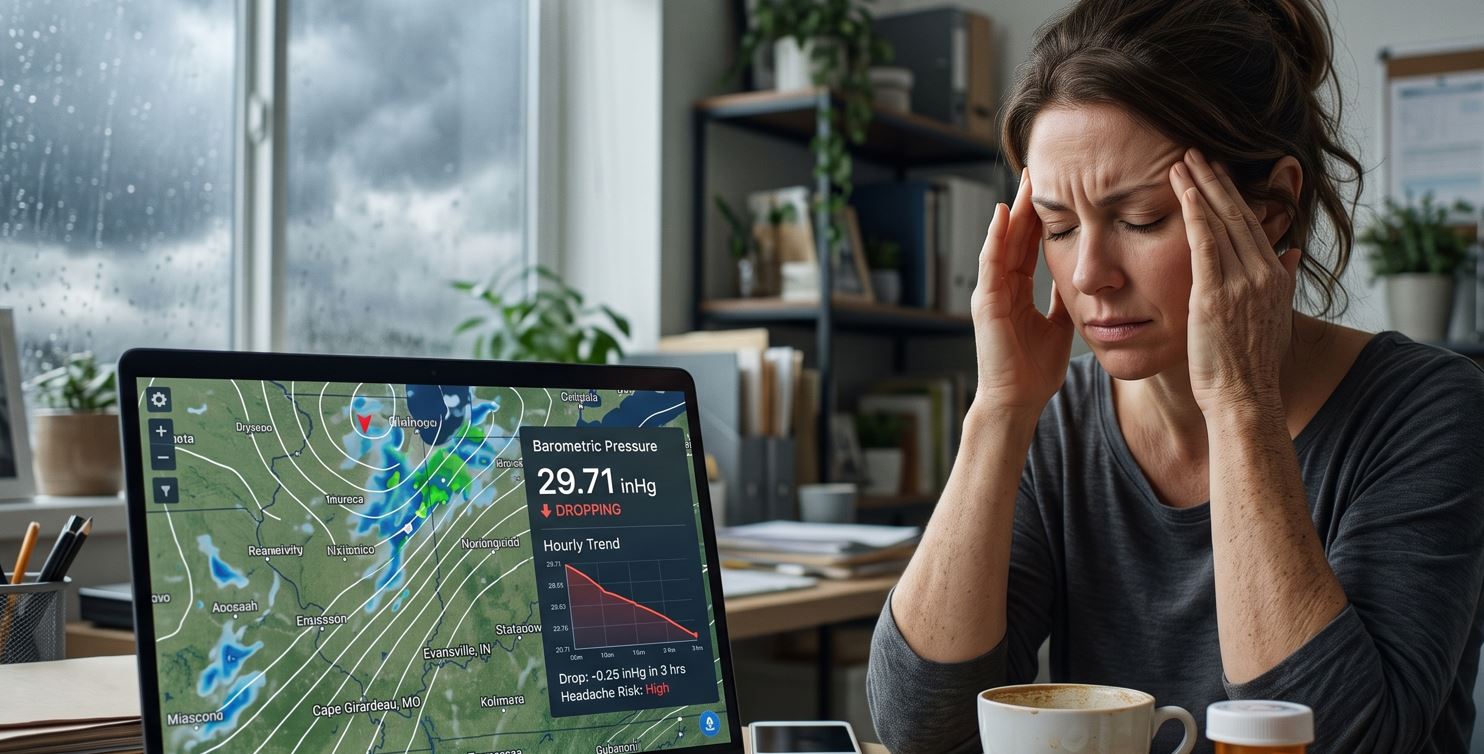
When the barometric pressure drops suddenly, it usually means a low-pressure system is moving in. The air rises, cools, condenses—and boom, clouds, rain, and potential storms follow. If you notice a sharp drop on your hourly tracker? Grab an umbrella. Or at least check the radar before you leave the house.
But here’s where it gets personal.
Is Barometric Pressure Causing My Headache Today?
I’m not a doctor—let’s get that out of the way. But I am someone who’s spent way too many afternoons Googling “barometric pressure headache” while lying in a dark room, convinced the sky was out to get me.
And the science backs it up. Your sinuses and inner ears are filled with air. When the outside pressure drops quickly, it creates a sudden imbalance between the pressure outside and the pressure inside your head. The result? Migraines, sinus tension, joint pain, and that weird sluggish feeling that makes you want to cancel all your plans.
Research supports this connection. A study published by the National Library of Medicine observed that a decrease in barometric pressure is often associated with an increase in headache occurrences in migraine patients. It is believed that these atmospheric changes affect the pressure in the brain and the way nerves signal pain.
So no, you’re not imagining it. The sky is out to get you. But at least now you know why.
At What Point Does Barometric Pressure Affect Your Body?
Most people start feeling symptoms when the pressure drops below 29.80 inHg or when there’s a rapid shift—think a change of more than 0.20 inHg in just a few hours.
On the flip side, high pressure (above 30.20 inHg) usually brings clear, sunny skies and significantly fewer health complaints. It’s the weather equivalent of a chill Sunday afternoon—no drama, no headaches, just… calm.
Is 29.95 Barometric Pressure High or Low?
You check your dashboard, see 29.95, and think: “Is that good? Bad? Should I be worried?”
Here’s the cheat sheet:
| Reading (inHg) | What It Means | What to Expect |
| Below 29.80 | Low pressure | Rain, storms, potential headaches |
| 29.80 – 30.20 | Normal range | Stable weather, minimal symptoms |
| Above 30.20 | High pressure | Clear skies, calm conditions |
Standard sea-level pressure is 29.92 inHg. So a reading of 29.95? That’s normal to slightly high. Calm weather, stable conditions, no extreme storms. And unless you’re unusually sensitive, probably no pressure-related headaches either.
Breathe easy.
Frequently Asked Questions
Ah, the classic confusion. You’re not the first to ask this—and you won’t be the last.
Barometric pressure is not measured in Celsius. Celsius is for temperature. Pressure is measured in inches of mercury (inHg) in the US, or millibars (mb) and hectopascals (hPa) internationally.
Think of it this way: you wouldn’t measure your weight in miles per hour, right? Same energy here.
The best way? Use a specialized weather pressure map online, or download a barometer app that taps into your smartphone’s internal barometric sensor for real-time, hyperlocal data. Some phones actually have this built in—who knew, right?
Final Thoughts (And Why This Actually Matters)
Here’s the thing: most weather sites give you the number and call it a day. They don’t explain why it matters. They don’t tell you that a sudden drop might trigger a migraine, or that a steady reading means you can probably skip the ibuprofen.
That’s the gap we’re filling here.
Because knowing the barometric pressure today near me isn’t just about being a weather nerd. It’s about understanding how the atmosphere affects your body, your plans, and your day. And honestly? That’s information worth having.
Tip: Bookmark this page and check back tomorrow morning to see how the pressure is trending before your day starts.
External Resource
For authoritative weather data and real-time pressure readings, check out the National Weather Service at weather.gov—the gold standard for atmospheric pressure information in the US.