

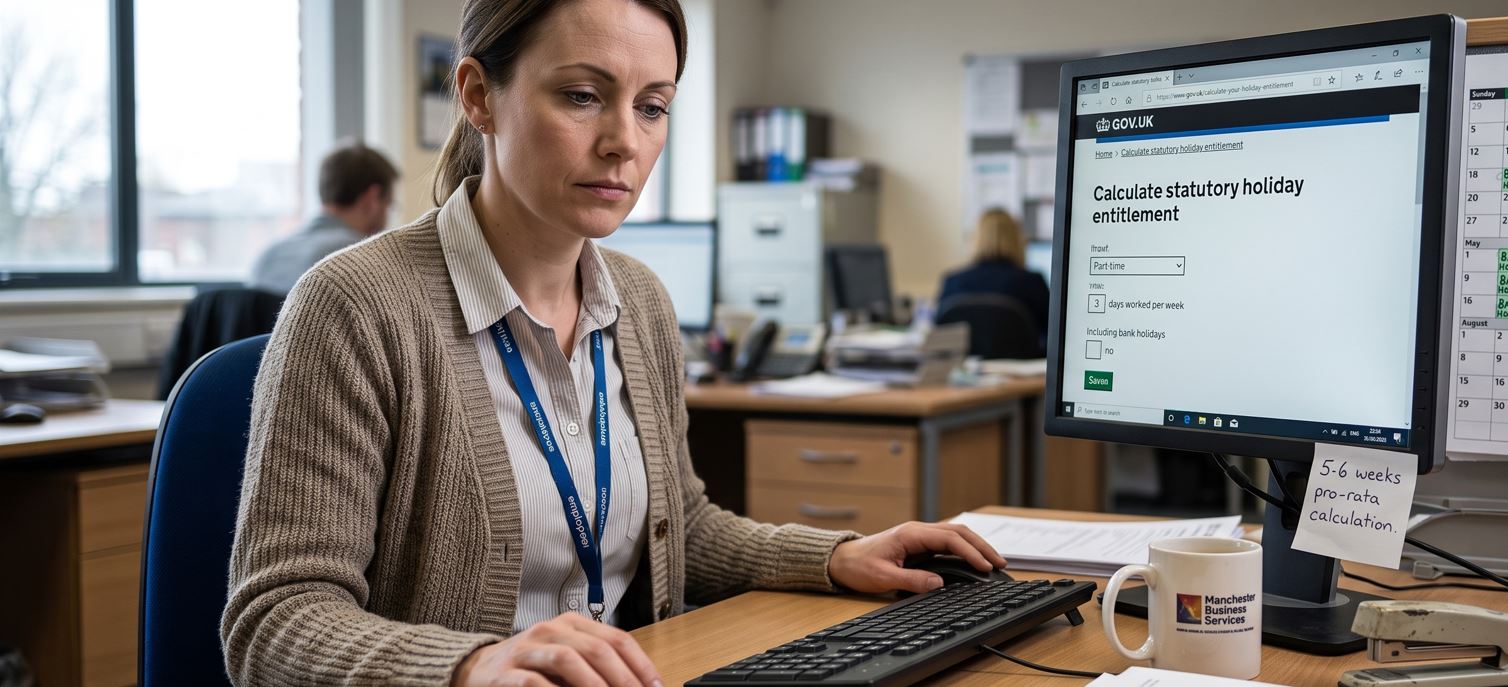
Let’s skip the bureaucratic fluff and get straight to the point: Yes, part-time workers in the UK are legally entitled to bank holidays.
The golden rule is the “pro-rata” principle. By law, you get 5.6 weeks of paid holiday a year, just like full-time staff. For a full-timer working 5 days a week, that’s 28 days (often split as 20 regular days + 8 bank holidays). If you work part-time, your total entitlement is simply calculated by multiplying the number of days you work a week by 5.6.
No guesswork, no favors from your boss. Just math.
I remember a few years back, sitting down with a colleague who was literally in tears trying to decode her payslip. She worked Wednesdays to Fridays and thought she was losing out on every single Monday bank holiday. Spoiler alert: she wasn’t. Because reading through the official ACAS manual is roughly as fun as watching paint dry in a damp London flat, we’re going to break this down into plain English.
The “Pro-Rata” Fairness Rule (And Why It Protects You)
Under the Part-time Workers (Prevention of Less Favourable Treatment) Regulations, employers cannot legally treat you worse than a full-time equivalent.
If full-timers get paid time off for bank holidays, you must get a proportional share of that benefit—even if you never actually work on a Monday. Period.
To make your life easier—and before you pull out your phone calculator—here is the definitive quick-reference table for statutory minimums:
| Days Worked Per Week | Total Annual Holiday Entitlement (Including Bank Holidays) |
| 1 day a week | 5.6 days |
| 2 days a week | 11.2 days |
| 3 days a week | 16.8 days |
| 4 days a week | 22.4 days |
| 5 days a week | 28 days (Full-time standard) |
Note: If your calculation results in a fraction of a day (like 16.8), your employer cannot round it down. They must either give you the fraction, round it up to 17, or pay you the 0.8 difference if you leave the company.
Answering Your Biggest Headaches (The Real FAQs)
If you’re scouring Google for answers, you probably fall into one of these specific scenarios. Let’s tackle them head-on.
How many bank holidays am I entitled to if I work 3 days a week?
This is the most common setup. If you work 3 days a week, your total statutory holiday allowance is 16.8 days for the year (3 days x 5.6 weeks).
How those bank holidays are handled depends on your contract. If your office closes on bank holidays and you normally work Mondays, your employer will likely deduct those bank holidays from your 16.8 total.
What happens if a bank holiday falls on a day you don’t work?
Ah, the classic “Wednesday-to-Friday” dilemma. If you don’t normally work Mondays, you do not automatically get the Monday off (because you’re already off!).
However—and this is the crucial part—you do not lose your allowance. Your pro-rata share of the bank holidays is already baked into your total holiday entitlement (e.g., your 16.8 days). You get to use that proportional time off on other days of the year. It’s the only way to keep things mathematically fair compared to your Monday-to-Friday colleagues.
Do I lose bank holidays if I work part-time shifts or irregular hours?
Absolutely not. If your hours vary every week, calculating days becomes a nightmare. In my experience, the only sane option here is for employers to calculate your holiday allowance in hours, not days.
If a full-timer works 40 hours a week and gets 224 hours of holiday (28 days x 8 hours), and you work an average of 20 hours a week, you get 112 hours of paid leave. When a bank holiday rolls around and your workplace is closed, your employer just deducts your scheduled hours for that day from your 112-hour pot. Simple.
Why the “Just Give Them the Day Off” Approach Fails
Many small business owners try to be “chill” and just say: “If the bank holiday falls on your working day, you get it paid. If not, too bad.”
Let me be incredibly clear: This is illegal if it leaves you with less than your 5.6 weeks of pro-rata statutory leave.
Because most bank holidays in the UK fall on a Monday or Friday, employees working Tuesdays to Thursdays consistently lose out under this lazy system. If your HR department is doing this, send them a link to the official statutory holiday entitlement rights on Gov.uk as a gentle (but firm) reminder.
The Bottom Line: Know Your Worth
Figuring out your bank holiday entitlement as a part-time worker shouldn’t feel like taking a Bar exam. The formula is your best friend: Days worked per week × 5.6.
Don’t let confusing contracts rob you of your legal rest time. Whether you use those hard-earned fractional days to binge-watch Netflix on a rainy Tuesday or take a long weekend in Cornwall, they are yours by law. Claim them.