

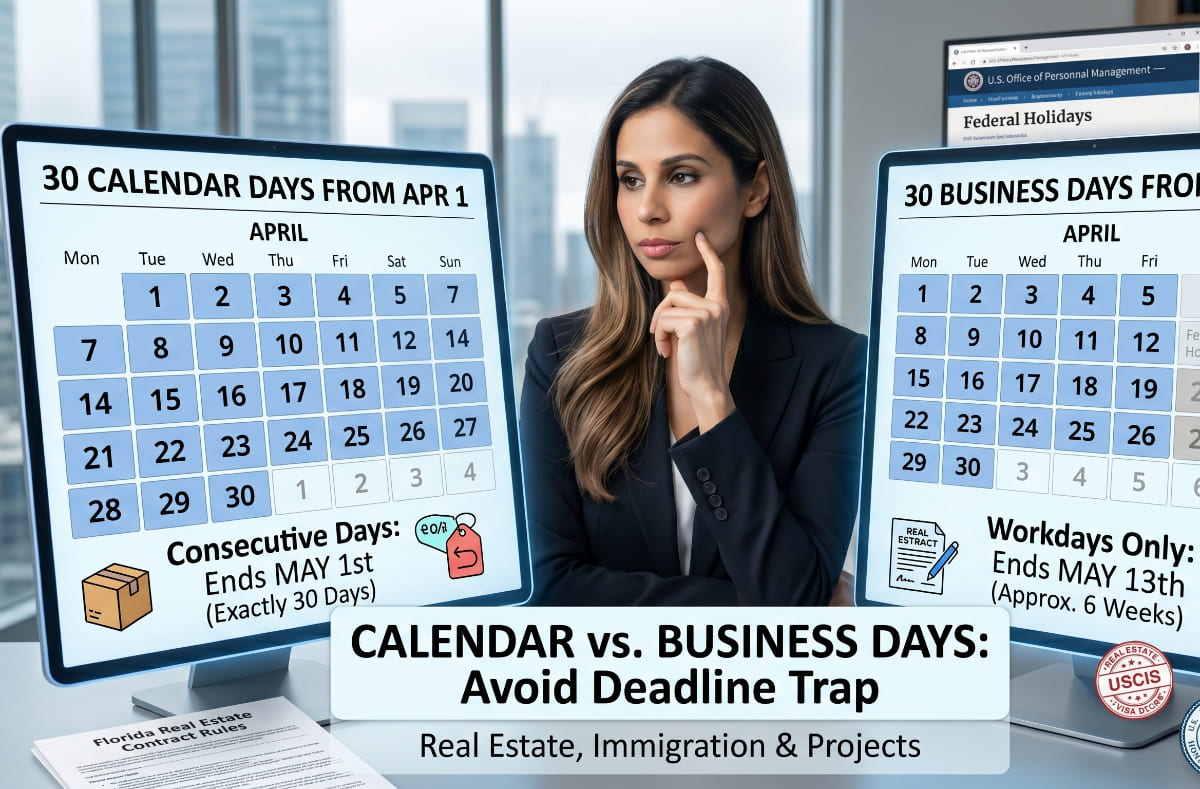
Calendar days are every day on the calendar, including Saturdays, Sundays and public holidays. Business days are Monday through Friday, minus holidays. Five business days usually take seven calendar days; when a holiday falls in the window, they take longer.
Today is Tuesday, November 17, 2026. 10 days after is . 10 business days after is , excluding United States (federal) holidays.
What are calendar days?
A calendar day is any day of the week. When a contract, return policy or notice says “30 calendar days”, you count every day in a row: weekdays, weekends and holidays alike. Nothing is skipped. That is the whole meaning of the term, and it is why “calendar days” is the simpler of the two counts.
Some documents just say “days”. In most US contracts and policies, plain “days” is read as calendar days unless the text says otherwise, but check the definitions section of the document before you rely on that.
What are business days?
A business day (also called a working day) is a weekday that is not a public holiday. In the United States that normally means Monday to Friday, excluding the federal holidays published by the U.S. Office of Personnel Management. Banks follow the Federal Reserve calendar, which differs on a few days a year.
Here is how today counts: Yes. is a business day for United States (federal).
A full US year has about 250 business days against 365 calendar days. See how many business days are in a year for the exact count by month.
Does calendar days include weekends?
Yes. Calendar days always include weekends and holidays. If a 14-calendar-day window starts on a Friday, both weekends inside it count toward the 14. Business days are the count that leaves weekends out.
What happens when a calendar-day deadline ends on a weekend depends on the rule behind it. Many court rules and some contracts move the last day to the next business day; others do not. Read the clause rather than assuming.
Calendar days vs business days from today
The table counts the same number both ways, starting from today. Counting starts the day after today, and US federal holidays are skipped in the business-day column. It updates every day.
| Days after today | Date in calendar days | Date in business days (US federal) |
|---|---|---|
| 5 | ||
| 7 | ||
| 10 | ||
| 14 | ||
| 30 | ||
| 60 | ||
| 90 |
For 30 days the gap is large: 30 business days is about six weeks of real time, so it ends roughly 12 to 14 calendar days later than 30 calendar days. See 30 business days from today for that date on its own.
How to convert business days to calendar days (and back)
The quick rule of thumb is the 5-to-7 ratio: every full week has 5 business days and 7 calendar days.
- Business days to calendar days: multiply by 7 and divide by 5. 10 business days ≈ 14 calendar days; 20 business days ≈ 28 calendar days.
- Working days to calendar days works the same way when the work week is Monday to Friday.
- Calendar days to business days: multiply by 5 and divide by 7. 30 calendar days ≈ 21 business days (20 to 22, depending on the start day).
- Subtract one business day for each holiday that falls on a weekday inside the window.
The ratio is an estimate. The exact result depends on which weekday you start on and which holidays fall in between, so for a real deadline use the business days calculator, which counts the actual days between two dates.
Where each count is used
| Usually calendar days | Usually business days |
|---|---|
| Store return windows (for example “return within 30 days”) | Shipping and processing times (“ships in 3–5 business days”) |
| Lease and rental notice periods | Bank transfers and check clearing |
| Free trials and subscription cancellations | Government and agency processing times |
| Many contract cure and notice periods | Refunds to a card or bank account |
Shipping is the most common place people meet business days. What business days mean in shipping covers cutoff times, Saturdays and carrier holidays.
Frequently asked questions
What does calendar days mean?
Calendar days means every consecutive day, with no days skipped. Weekends and holidays count the same as weekdays.
Are calendar days and business days the same?
No. Calendar days include all seven days of the week. Business days include only Monday to Friday and leave out public holidays, so the same number of business days always ends on the same date or later.
How many calendar days is 10 business days?
Usually 14 calendar days, because 10 business days span two full weeks. A weekday holiday inside the window adds one more day.
Is 30 calendar days the same as one month?
Not exactly. Months have 28 to 31 days, so 30 calendar days from a given date can land a day or two before or after the same date next month.
Do calendar days include holidays?
Yes. A holiday is still a calendar day, so it counts toward a calendar-day deadline. It does not count toward a business-day deadline.